Look up on a clear day and the sky is blue. Look at the same place at sunset and it can turn orange and red. The Sun hasn't changed. What changed is the path its light takes through the air.
Sunlight is a mix of colours
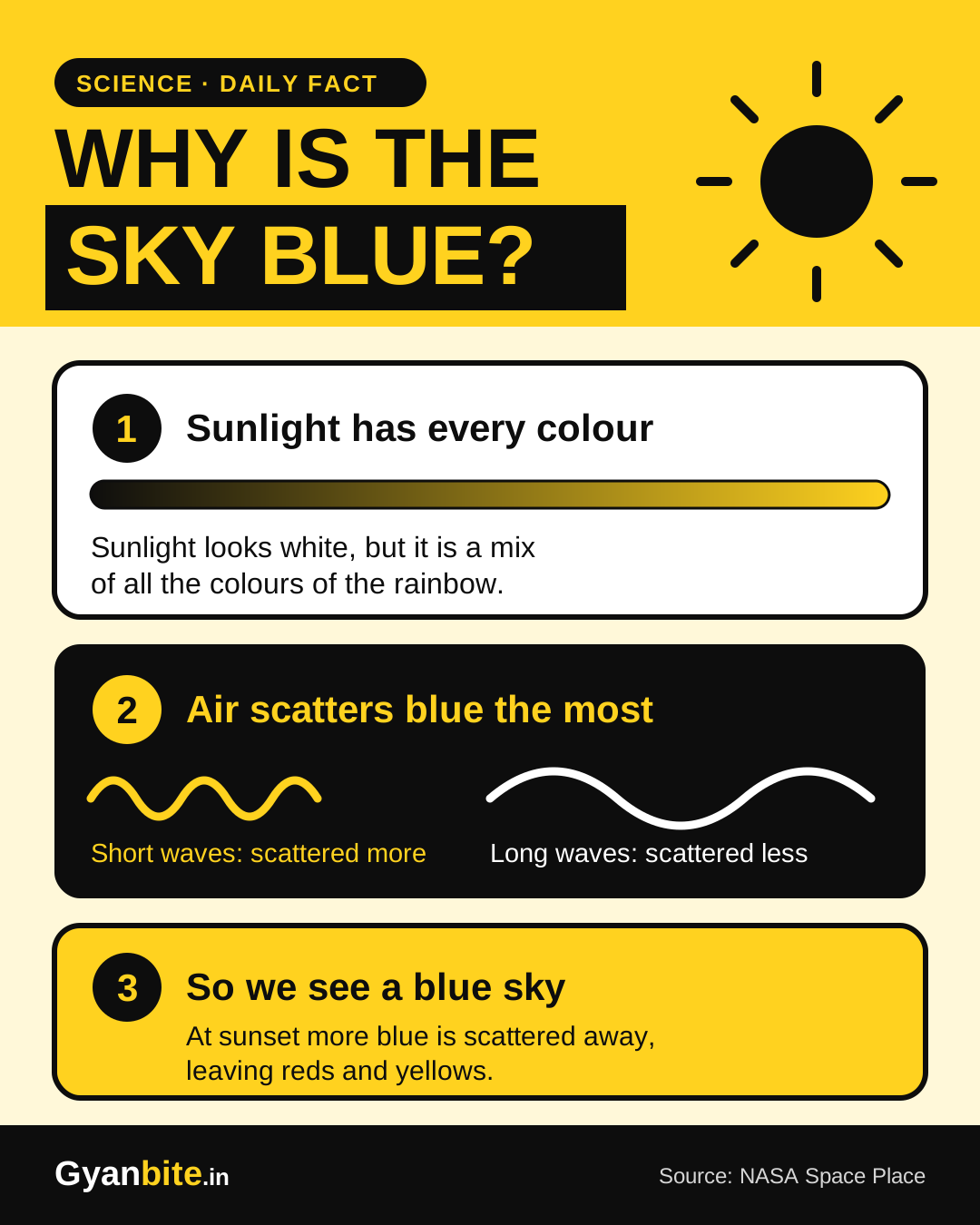
Light from the Sun looks white, but it is really made of all the colours of the rainbow. A prism proves this by splitting white light into its separate colours. Each colour travels as a wave, and the waves are different sizes: blue light has shorter waves than red light.
Air scatters blue light the most
Light normally travels in a straight line until something reflects, bends or scatters it. When sunlight enters Earth's atmosphere, the gas molecules in the air scatter it in every direction. Because blue travels in shorter, smaller waves, it is scattered more than the other colours. That scattered blue light comes to your eyes from all over the sky, which is why the sky looks blue most of the time.
Why the sky is paler near the horizon
Look toward the horizon and the sky fades to a lighter blue or even white. Light from low in the sky has passed through much more air than light from directly overhead. On the way, the blue gets scattered and re-scattered many times, and the ground reflects and scatters light too. All that mixing brings the colours back together, so you see more white and less blue.
Why sunsets are red and orange
When the Sun is low, its light crosses far more of the atmosphere before it reaches you. More of the blue is scattered out of the direct beam, so the reds and yellows are what get through. Dust, pollution and other tiny particles can add to the effect, which is why some sunsets glow so strongly.
Is the sky blue on other planets?
It depends on what is in the atmosphere. Mars has a thin atmosphere of mostly carbon dioxide, full of fine dust. Images from NASA's Mars Pathfinder lander show an orange or reddish sky by day and a blue-gray tone around the Sun at sunset, which is the reverse of what we see on Earth.
Quick facts
- Sunlight looks white but contains all the colours of the rainbow.
- Blue light has shorter waves than red light and is scattered more by air.
- The sky looks paler near the horizon because light is scattered many times.
- Sunsets look red because more blue is scattered away on the long path through the air.
- Mars shows the opposite pattern: an orange sky by day and a blue-gray tone at sunset.
Sources
- NASA Space Place — Why Is the Sky Blue? (NASA Science)